



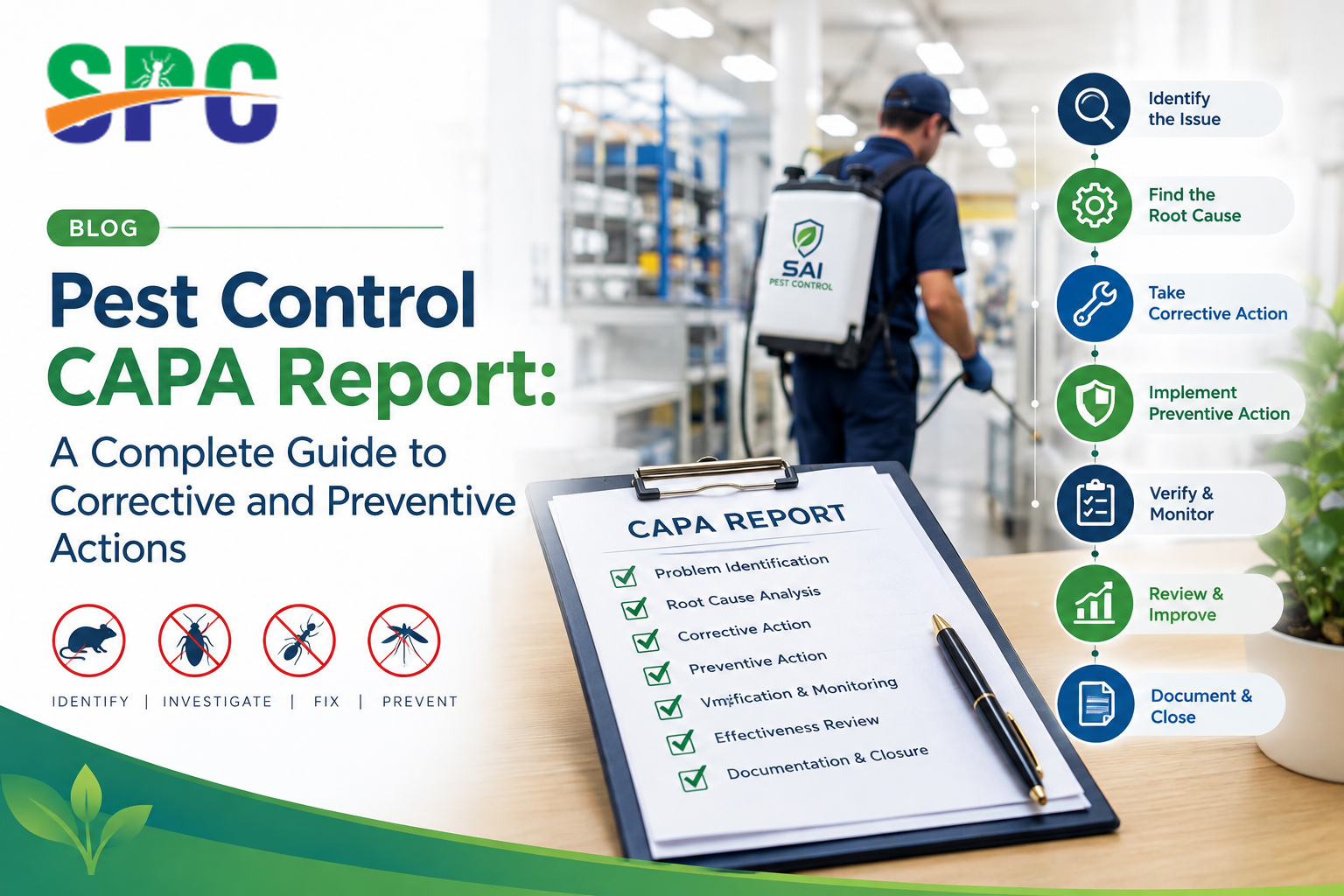
Why Is a Pest Control CAPA Report Important?
A Pest Control CAPA Report helps you look beyond the pests you can see. In commercial and industrial sites, you also need to know what caused the problem. Then you need to know how your team fixed it and how to stop it from coming back.
First, the report gives you a clear way to record and manage these issues. CAPA stands for Corrective Action and Preventive Action. Pest control teams and facility managers use it to look into incidents, assign tasks, and track results. As a result, everyone keeps a clear record of the fix.
Indeed, this approach works well in food plants, warehouses, factories, hospitals, hotels, restaurants, and offices. In these places, pests can harm hygiene, product quality, and worker safety. They can also put food safety compliance at risk. Even a single sighting can lead to an audit finding.
Our team supports both commercial pest control and industrial pest control clients across Tamil Nadu.
What Does a Pest Control CAPA Report Include?
A good report covers seven key areas. Let's look at each one.
1. Problem Identification
First, write down exactly what you saw. Then include these details:
- Type of pest found
- Exact location of the activity
- Date and time you saw it
- Signs of pests, such as droppings or damage
- How bad the problem is
In fact, accurate details give your team a clear starting point. They also help later, when someone reviews the case.
2. Investigation and Root Cause Analysis
However, finding pests is only half the job. Next, ask why they got in or stayed in the area. Common causes include:
- Gaps, cracks, or damaged doors
- Piles of waste
- Poor housekeeping
- Standing water or damp spots
- Badly stored food
- Drain problems
- Open gaps that nobody sealed
- Weak spots in the building
When you find the real cause, you can fix it. As a result, you no longer need to rely on repeat treatments.
3. Corrective Action
Once you know the cause, corrective action deals with the problem you already found. Depending on the case, your team may treat the pests, remove waste and food sources, or clean the area. They may also repair damaged spots and close entry points.
Then, record each step clearly. That way, the team can check what they actually finished.
4. Preventive Action
After that, preventive action lowers the chance of the same problem coming back. For example, you can:
- Improve cleaning and sanitation habits
- Tighten your waste-management routine
- Seal spots where pests can enter
- Store food and supplies the right way
- Control moisture and fix drainage
- Inspect the site more often
- Add or upgrade monitoring devices
Make sure the plan targets the causes you found during the investigation. Otherwise, the same issue may return.
5. Responsibility and Timeline
Because tasks slip easily, every action needs an owner and a deadline. Your report can list:
- Action to complete
- Person or team in charge
- Target date
- Actual finish date
- Current status
With this list, managers and pest control teams can track open tasks. Therefore, no recommendation gets missed.
6. Verification and Monitoring
Finishing an action does not prove the problem is gone. So, plan follow-up checks. Inspections and monitoring show whether pest activity has dropped. They also show whether your changes work.
In addition, monitoring records reveal patterns. This helps most when the same issue keeps showing up in one area.
7. Effectiveness Review
After you carry out the fixes, check how well they work. Ask these questions:
- Is pest activity lower or gone?
- Did the team correct the causes you found?
- Have monitoring results improved?
- Do you need extra steps?
If the problem continues, go back to the investigation. After that, add more actions where needed.
Key Benefits of a Pest Control CAPA Report
When you keep it up to date, a CAPA process brings several practical benefits:
- Fewer repeat pest problems, because you fix the causes
- Better accountability, since each task has an owner
- Easier audit prep, thanks to organized records
- Clearer talks between pest control providers and facility teams
- Faster spotting of trends across sites or areas
- Less disruption from repeat pest issues
Instead of treating each pest issue as a one-off, CAPA helps you learn from it. As a result, your future control measures get stronger.
When Should You Prepare a Pest Control CAPA Report?
Prepare a report when your site has any of these problems:
- Repeat pest activity in the same spot
- A large infestation
- Complaints from customers or staff about pests
- Findings from internal inspections
- Issues from outside audits
- Pests tied to cleaning or building problems
- Control measures that failed earlier
- Cases that need written corrective and preventive actions
However, the exact rules vary. They depend on your quality system, your industry, customer needs, and local regulations.
How Does a Pest Control CAPA Report Improve Pest Management?
While traditional pest control mainly finds and treats pests, CAPA adds a second layer because it also looks at the conditions around the incident.
For example, imagine a food-service area where cockroaches keep coming back. Treatment may cut the pest numbers for a while. However, a CAPA investigation goes further. It checks waste handling, food storage, drainage, cleaning habits, and entry points.
As a result, the facility stops just reacting to incidents. Instead, it manages the factors behind them.
Pest Control CAPA Report FAQs
1. What is a Pest Control CAPA Report?
A Pest Control CAPA Report is a written record of a pest issue. It shows the causes, the corrective and preventive steps, and the results.
2. What does CAPA stand for?
CAPA stands for Corrective Action and Preventive Action. Corrective action fixes a problem that already exists. Preventive action, on the other hand, lowers the chance of it happening again.
3. Why is root cause analysis used in pest control?
Root cause analysis finds the conditions that helped pests thrive. These may include poor cleaning, gaps in walls, moisture, waste, or easy access to food.
4. When should you create a Pest Control CAPA Report?
Create one for repeat pest activity, large infestations, complaints, or audit findings. You can also use it whenever your site needs written corrective and preventive steps.
5. How do you check CAPA effectiveness?
You can check it with follow-up inspections, monitoring records, and pest activity trends. In addition, confirm that the team finished every action and that the actions work.
Conclusion
In conclusion, good pest management takes more than reacting to the pests you can see. A Pest Control CAPA Report gives you a clear record. With it, you can investigate incidents, fix the causes, assign tasks, and check the results.
When you add CAPA to your wider pest management program, you handle incidents more consistently. Also, it supports hygiene, documentation, and steady improvement.
The goal is not just to remove today's pests. Instead, understand what caused them and build a system that stops future problems.
Need help with pest control at your site? Contact Sai Pest Control to book a free inspection.
Comments are closed